

Two industrial environments break lighting faster than anything else: wash-down areas and cold storage. They fail fixtures for opposite reasons, which is why a single industrial vapour tight light fixture specification rarely covers both well.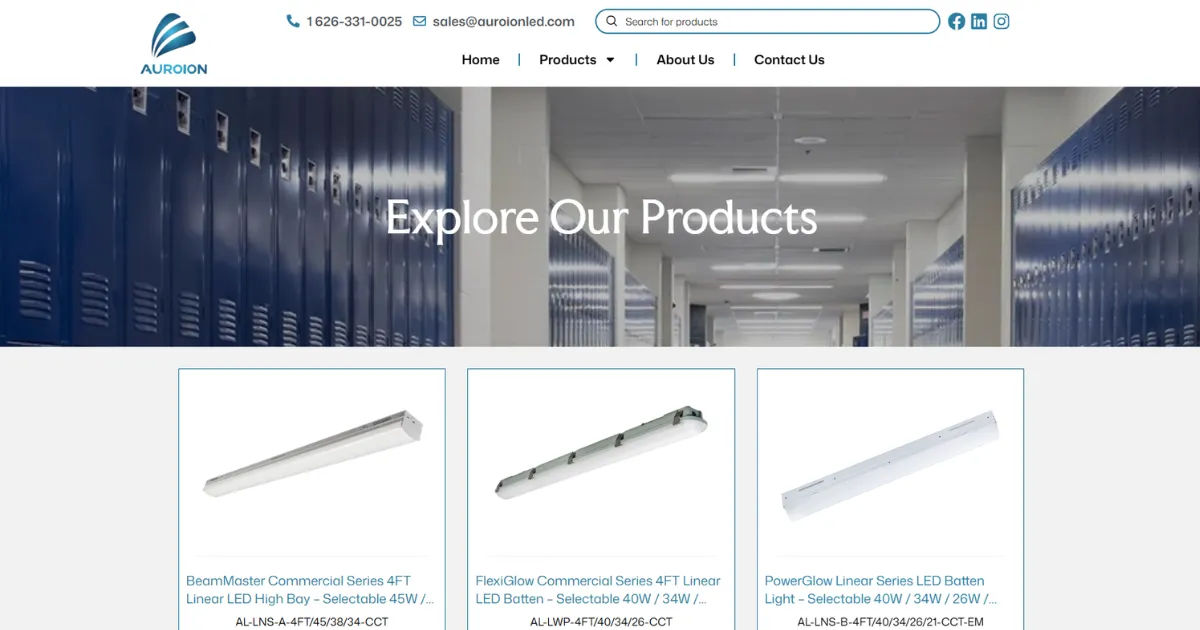
Wash-down kills fixtures with water pressure and thermal shock. Cold storage kills them with condensation cycling and drivers that won’t start. Understanding both makes the spec sheet much easier to read.
Wash-Down: Pressure and Thermal Shock
A commercial pressure washer delivers 1,500-3,000 PSI. IP66 is tested at roughly 15 PSI. No fixture on the market is rated to take a pressure washer at close range on the gasket line, which means the specification is about survivability at reasonable distance, not invulnerability.
Two things determine survival:
Gasket compression. A moulded silicone gasket held by six or more stainless clips across a 4-foot fixture maintains even pressure along the whole seal. Cut-strip gaskets with two clips have a soft middle and that’s where water enters.
Thermal shock tolerance. This is the one people miss. A fixture running at 45-55°C internal temperature hit with 10°C water contracts fast. Repeat that daily and cheap housings develop micro-cracks at stress points, usually near the mounting holes. Polycarbonate handles it. Some low-cost composites don’t.
Training matters as much as product. Washing crews who hit fixtures directly from three feet away will destroy anything. A standing instruction to keep the wand at six feet or more and avoid direct gasket spray extends fixture life more than any upgrade you can buy.
Cold Storage: The Driver Is the Problem
Freezer and cooler installations fail at the driver, not the diodes. LEDs actually run more efficiently cold — output rises slightly at low temperature. The driver is where it goes wrong.
Check the minimum ambient temperature rating explicitly. Many industrial vapour tight fixtures are rated -20°C, which handles a cooler at 2-4°C easily but is marginal in a blast freezer running at -25°C. Below -30°C you need a driver specifically rated for it, and the options narrow considerably.
The second cold storage issue is condensation cycling. Every time a freezer door opens, warm humid air enters and condenses on cold surfaces including your fixtures. A properly sealed IP66 housing keeps that moisture outside the electronics. A fixture with a compromised gasket accumulates water internally, and in a freezer that water becomes ice, which expands and destroys whatever it’s touching.
Chemical and Corrosive Environments
Wastewater treatment, plating, fertiliser storage and livestock buildings share a problem: the air itself attacks the fixture.
Ammonia in agricultural buildings degrades standard polycarbonate over time and corrodes any exposed metal. Chlorine in water treatment does the same faster. In these environments:
- Fiberglass or chemically resistant polycarbonate housings, not steel
- Stainless steel 316 hardware rather than 304 where salt or chlorine is present
- Sealed cable glands rather than open knockouts
- Gasket material confirmed compatible with the specific chemical present
Ask the supplier for chemical compatibility data. If they can’t produce it, that tells you something about the product.
Impact and Mounting
Industrial spaces have forklifts, pallet trucks and people carrying long items. IK08 is the practical minimum for anything mounted below 14 feet in a traffic area. IK10 where mast strikes are a realistic possibility.
Chain and cable mounting gives a fixture somewhere to go when it’s clipped, which frequently saves it. Rigid surface mounting transfers the full impact into the housing.
Auroion LED supplies industrial vapour tight fixtures for cold storage and wash-down areas with specified low-temperature ratings and IP66 sealing, alongside industrial LED high bay lights for tall warehouse ceilings where the same facility needs coverage at height.
Frequently Asked Questions
What temperature rating do I need for freezer lighting?
Match the driver rating to the coldest operating temperature, not the average. Coolers at 2-4°C are fine with a -20°C rating. Blast freezers at -25°C or below need a driver explicitly rated for that range, which is a smaller product set.
Will pressure washing damage vapour tight fixtures?
Direct close-range spray will damage any fixture. IP66 units survive normal wash-down at reasonable distance. Instruct cleaning crews to keep the wand at least six feet from fixtures and avoid aiming directly at the gasket line.
Do industrial vapour tight fixtures work in ammonia environments?
Only with the right materials. Standard polycarbonate degrades in high ammonia concentrations over several years. Specify fiberglass or chemically resistant housings with stainless hardware and confirm gasket compatibility with the supplier.
Why do my fixtures have water inside them?
Almost always a gasket problem — either compression is uneven between clips, the gasket is a cut strip with a leaking joint, or a cable entry was never sealed at installation. Condensation from temperature cycling is the second cause in cold environments.