

A busy embroidery shop needs more than good machines and quality thread. It also needs accurate designs that stitch cleanly, hold their shape, and look professional on the finished product. 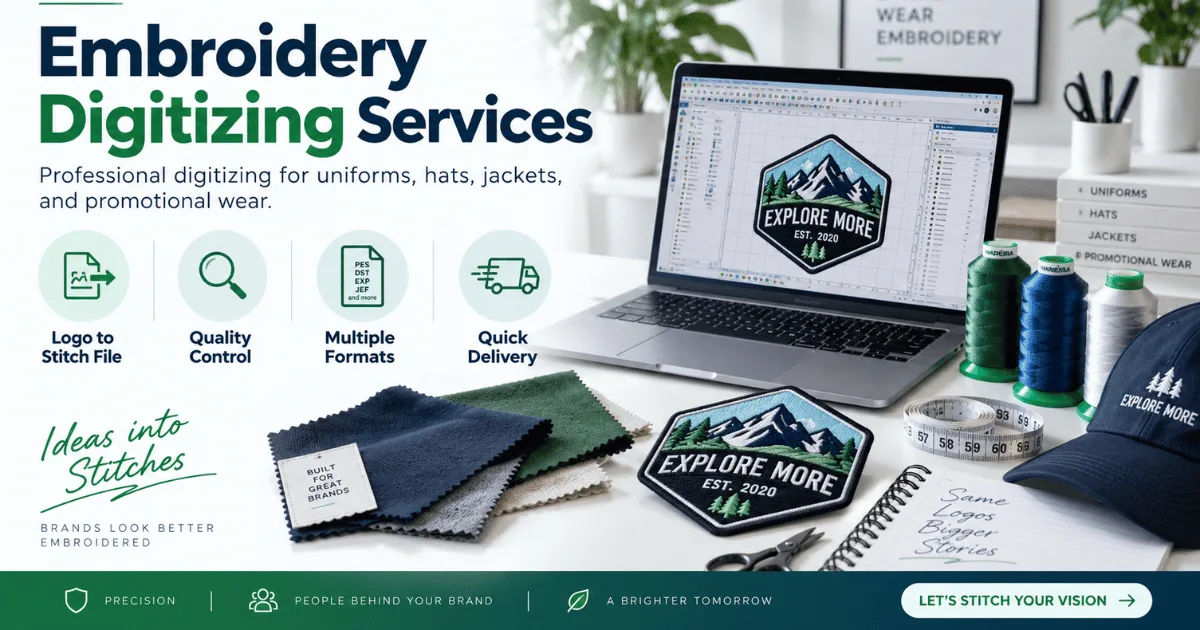 This is where professional embroidery digitizing services can make a major difference. Instead of turning artwork into stitch files through trial and error, shops can rely on trained digitizers who understand stitch types, fabric behavior, density, underlay, sequencing, and machine requirements.
For embroidery businesses, good digitizing is not simply a technical step. It affects production speed, product quality, customer satisfaction, material waste, and profit. When a shop receives a well-prepared file, its machines can usually run more smoothly, while operators spend less time fixing problems. The result is a more dependable workflow from artwork submission to finished garment.
What Is Embroidery Digitizing?
Embroidery digitizing is the process of converting artwork, logos, lettering, or other graphics into a digital stitch file that an embroidery machine can read. A digitizer decides how each part of the design should be sewn.
A simple image does not automatically tell a machine where to place stitches. The digitizer must create stitch paths, choose stitch types, set densities, plan thread changes, and arrange the sewing sequence. They must also consider the fabric and the final size of the design.
Different areas may require different techniques. Satin stitches can work well for borders and narrow lettering, while fill stitches are useful for larger shapes. Running stitches may be suitable for fine details. Good digitizing combines these methods so the final embroidery looks balanced rather than bulky or uneven.
Why Shops Need Professional Digitizing
An embroidery shop may have experienced machine operators, but operating a machine and creating a high-quality stitch file are different skills. A strong operator can manage thread, hoops, needles, tension, and machine settings, while a skilled digitizer focuses on how artwork should be constructed in stitches.
Using professional embroidery digitizing services gives shops access to specialized knowledge without requiring every employee to become an advanced digitizer. This can be especially useful for small businesses that receive many different types of artwork.
Professional digitizing can also help shops avoid repeated testing. Poorly prepared files may cause thread breaks, puckering, gaps, excessive density, registration problems, or unnecessary trims. Fixing these issues after production has started can cost more than having the design prepared correctly in the first place.
Better Design Quality
Customers usually judge an embroidery shop by the finished product. If a logo has jagged edges, distorted lettering, uneven fills, or poor registration, the customer may not understand why the problem happened. They simply see a result that does not meet expectations.
Professional embroidery digitizing services help shops produce cleaner designs by planning every stitch area carefully. Digitizers can adjust stitch direction, density, pull compensation, and underlay to suit the artwork and fabric.
This attention to detail is important for logos with small text, curved shapes, outlines, or multiple colors. A design that looks perfect on a computer screen may not stitch well without careful preparation. Professional digitizing bridges that gap between digital artwork and physical embroidery.
Faster Production
Time is one of the most valuable resources in an embroidery shop. When a design file works correctly on the first or second test, production can move forward without unnecessary delays.
A professionally prepared file can reduce the amount of troubleshooting required by operators. There may be fewer thread breaks, fewer stops, fewer manual corrections, and less need to edit the file during production.
This does not mean every professionally digitized design will run perfectly without testing. Fabric, thread, needle choice, hooping, and machine settings still affect the result. However, a strong starting file makes the production process much more predictable.
For shops handling regular customer orders, professional embroidery digitizing services can make it easier to maintain a steady production schedule. Consistent files reduce interruptions and allow employees to concentrate on completing orders rather than repeatedly correcting artwork.
Reduced Material Waste
Embroidery mistakes can waste garments, stabilizer, thread, and machine time. If a design pulls badly or has excessive density, the shop may need to stop production or even replace a garment.
Careful digitizing helps control stitch counts and density. It can also reduce unnecessary movement and trims when the design allows it. Efficient stitch planning means the machine is doing useful work rather than spending excessive time on avoidable details.
For shops handling large orders, even a small reduction in waste can have a noticeable financial effect. Saving material on every garment can improve margins over hundreds or thousands of pieces.
Reliable professional embroidery digitizing services can therefore contribute to better cost control. Although the digitizing fee is an expense, it may help prevent larger expenses caused by rejected garments, repeated samples, and production delays.
Support for Different Fabrics
Not every garment behaves in the same way. Cotton, denim, fleece, jackets, caps, performance fabrics, and stretchy garments can respond differently to embroidery.
A design that works well on a stable woven shirt may need changes when used on a stretchy polo. Soft fabrics may need appropriate underlay and density control to prevent sinking. Heavy materials may require different settings to maintain definition.
Experienced professional embroidery digitizing services consider these differences when preparing files. They can recommend or create adjustments based on the intended application, helping shops avoid treating every fabric as if it were identical.
This flexibility is important for shops that serve different industries. A uniform supplier, for example, may embroider work shirts, jackets, hats, bags, and other products. Each application can require a slightly different approach.
Better Results on Caps and Hats
Caps present special challenges because the embroidery area is curved and the available space is limited. Stitch direction, center placement, sequencing, and density can all affect the final appearance.
Professional digitizing can be especially valuable for cap embroidery. A digitizer may simplify small details, adjust lettering, change stitch angles, and plan the design around the center seam or curved surface.
These adjustments help prevent designs from looking distorted when they are sewn on a curved panel. For shops that regularly embroider hats, reliable digitizing can become an important part of maintaining consistent quality.
A shop using professional embroidery digitizing services can also receive designs that are specifically prepared for the intended cap style. This can be more effective than simply using a standard flat-garment file on a curved surface.
Handling Small and Detailed Logos
Small logos are among the most difficult designs to digitize because there is less physical space for stitches. Tiny letters can close up, thin lines can disappear, and closely packed elements can become difficult to distinguish.
A professional digitizer knows when to simplify artwork rather than attempting to reproduce every tiny detail. Sometimes a small design needs fewer details, wider lettering, or a different stitch approach.
This is one reason professional embroidery digitizing services can help shops accept a wider range of customer artwork. The goal is not always to copy an image exactly. The goal is to create an embroidery version that communicates the same visual identity clearly.
Small lettering deserves particular attention. If text is too small or dense, it may become unreadable after stitching. A skilled digitizer can determine which details should remain and which should be adjusted for embroidery.
Multiple File Formats
Embroidery machines do not all use the same file format. Depending on the machine, a shop may need DST, PES, JEF, EXP, VP3, or another format.
Professional digitizing providers can often prepare the required machine formats from one master design. This is useful for shops serving customers who use different machines or production systems.
Having the right format reduces compatibility problems. It also saves shop employees from spending unnecessary time trying to convert or modify files without knowing whether the conversion will preserve important stitch information.
For shops working with multiple machines, professional embroidery digitizing services can make file management easier. Instead of creating a new design for every machine, the business can request the appropriate formats based on its equipment.
Improved Order Capacity
A shop's capacity is not determined only by the number of embroidery heads it owns. Workflow efficiency matters too.
When artwork is consistently prepared and organized, employees can spend more time producing orders and less time correcting design problems. This can help a shop handle more customer requests during busy periods.
Outsourcing digitizing can also make it easier for a small shop to accept complicated orders. Instead of turning away artwork that requires advanced digitizing, the shop can send it to a specialist and continue focusing on production and customer service.
This makes professional embroidery digitizing services useful for businesses that want to grow without immediately adding more specialized staff. The shop can increase its design capabilities while keeping its internal workflow manageable.
Consistent Branding for Customers
Businesses often order embroidered logos because they want consistent branding across uniforms, caps, jackets, bags, and other products. A logo should look recognizable even when it appears on different items.
A well-built master embroidery file can serve as a reliable foundation for different sizes and applications. The digitizer can make adjustments for each product rather than simply enlarging or shrinking the same stitch file.
This is important because resizing embroidery is not the same as resizing a digital image. A stitch file may need density, stitch length, and detail changes when its dimensions change.
Using professional embroidery digitizing services can help shops create more consistent branding across multiple products. Customers are more likely to appreciate a shop when the same logo maintains a professional appearance from one garment to another.
Better Customer Satisfaction
Customers want their finished products to match the artwork they approved. They also expect orders to be delivered on time.
Reliable digitizing supports both expectations. When designs stitch cleanly, there are fewer production surprises and fewer reasons to remake garments.
Good professional embroidery digitizing services can therefore contribute indirectly to stronger customer relationships. The service provider may never speak to the shop's customer, but the quality of its work can influence what that customer experiences.
Customer satisfaction can also lead to repeat business. When companies receive uniforms or promotional products that look polished, they may return when they need additional items.
Saving Staff Time
Digitizing can be time-consuming, particularly when a design contains several colors, detailed lettering, complicated shapes, or difficult embroidery effects.
When shop employees are responsible for every digitizing task, production management can become harder. A specialist can handle the design preparation while the shop team focuses on hooping, machine operation, finishing, packaging, and customer communication.
This division of work allows employees to concentrate on their strongest skills. It can also reduce interruptions during busy production periods.
For many businesses, professional embroidery digitizing services are therefore a practical way to outsource a specialized task. Employees can focus on production while experienced digitizers handle the technical preparation behind the scenes.
Access to Specialized Techniques
Some embroidery projects require techniques that are not used every day. These may include appliqué, 3D puff, fine lettering, gradients created through stitch effects, specialty underlay, or detailed satin borders.
Professional embroidery digitizing services can provide access to people who regularly work with these techniques. Their experience can help determine whether a particular effect is realistic for embroidery and how it should be constructed.
Specialized knowledge is valuable because embroidery has physical limitations. A design may look simple in artwork but require significant planning when converted into stitches.
A professional digitizer can also suggest practical alternatives. If an effect will not reproduce well at a particular size, the digitizer may recommend simplifying the design or changing the stitch method.
Quality Control and Testing
Testing is another major advantage of professional digitizing. A file can be examined for stitch density, sequencing, jumps, trims, color changes, and potential problem areas before full production.
Whenever possible, shops should test important designs on the actual or a similar fabric. This helps reveal issues that may not be obvious on screen.
A reliable provider may also make revisions after seeing the test result. This creates a feedback loop in which the design becomes better suited to the shop's machine and production conditions.
Good professional embroidery digitizing services understand that quality control is part of the process. The first file may sometimes require adjustments, especially when a design is being prepared for an unfamiliar material or product.
Cost Efficiency for Small Shops
Hiring a full-time digitizer may not make financial sense for every embroidery business. The shop may not have enough design work to keep a specialist occupied every day.
Outsourcing gives smaller businesses access to expertise when they need it. They can pay for specific projects rather than carrying the full cost of an additional employee.
The value becomes even clearer when considering the hidden costs of poor digitizing. Failed samples, wasted garments, machine downtime, rushed corrections, and missed deadlines can all reduce profit.
For this reason, professional embroidery digitizing services can be considered an investment in production efficiency rather than simply another business expense.
How to Choose a Reliable Digitizing Provider
Shops should look beyond low pricing when selecting a provider. Quality, communication, turnaround time, revision policies, file formats, and experience all matter.
Ask whether the provider understands the type of products the shop commonly embroiders. A company experienced with flat garments may not have the same level of expertise with caps, jackets, patches, or specialty items.
It is also useful to review samples. Look closely at small lettering, curves, corners, outlines, and dense areas. Strong samples can provide evidence of the provider's technical ability.
Communication is equally important. The digitizer should be able to ask sensible questions about size, fabric, placement, thread colors, and machine requirements when necessary.
A dependable professional embroidery digitizing services provider should also have a clear revision process. If the test reveals a problem, the shop should know how corrections will be handled and what information needs to be supplied.
Tips for Shops Working With Digitizers
Shops can improve results by sending clean artwork and complete project information. The more useful information the digitizer receives, the easier it is to create a suitable file.
Include the desired finished size, product type, fabric, placement, thread colors, and preferred file format when these details are known. If the design will be used on both caps and flat garments, mention that before digitizing begins.
Shops should also keep approved master files organized. Instead of repeatedly sending slightly different versions of a logo, maintaining a clear naming system can prevent confusion.
It is helpful to keep notes about successful settings and samples as well. Over time, this creates a useful production reference for recurring customer orders.
Clear communication with professional embroidery digitizing services can reduce misunderstandings and help the provider create files that match the shop's actual production needs.
The Business Impact of Professional Digitizing
The value of professional embroidery digitizing services goes beyond the design file itself. Better files can support smoother production, fewer mistakes, stronger product quality, and improved customer confidence.
For a growing shop, these advantages can affect profitability. Faster workflows allow more orders to move through the business. Reduced waste protects material costs. Consistent quality can encourage repeat customers and referrals.
Professional digitizing can also help a shop expand its services. When the business knows it has dependable design support, it may feel more comfortable accepting unusual logos, complex artwork, or larger orders.
A shop that combines good equipment with professional embroidery digitizing services can create a stronger production system. Machines handle the physical stitching, while experienced digitizers help ensure that the instructions sent to those machines are carefully prepared.
PSA Digitizing specializes in converting customer artwork into clean and professional embroidery files suitable for machine stitching. As a trusted embroidery digitizing company, it creates files in formats such as DST, PES, JEF, and other commonly requested types. Based in Clarkston, Georgia, USA, the team combines experienced craftsmanship with modern digitizing software to produce accurate designs while keeping its services practical and affordable.
With a 4.5+ star rating on Trustpilot, PSA Digitizing has earned recognition from embroidery businesses, decorators, and hobbyists looking for dependable digitizing support. Whether you need a company logo digitized, a custom patch prepared, or artwork converted into a machine-ready file, the goal is to provide precise work, quick turnaround, and a simple customer experience. Visit psadigitizing.com and get started today.
Conclusion
Professional embroidery is a combination of art, technology, machine operation, and production planning. A quality embroidery machine cannot compensate for a poorly constructed stitch file, just as a beautiful design cannot become a strong embroidered product without suitable digitizing.
For this reason, professional embroidery digitizing services are valuable partners for many embroidery shops. They help transform artwork into practical stitch files that are designed with fabric, machine behavior, stitch structure, and finished appearance in mind.
The benefits can appear at every stage of the workflow. Better digitizing can improve design quality, reduce production problems, limit material waste, support different fabrics and products, and save staff time. It can also make it easier for shops to manage detailed logos, caps, small lettering, multiple file formats, and specialty embroidery techniques.
The right provider should be viewed as more than someone who converts images into embroidery files. A skilled digitizer contributes technical knowledge that can improve how a shop produces and delivers its work.
For small businesses, outsourcing can provide specialized expertise without the expense of maintaining a full-time digitizer. For larger shops, it can increase capacity and provide additional support during busy periods.
Ultimately, successful embroidery depends on consistency. When artwork is digitized carefully and tested appropriately, shops have a stronger foundation for producing attractive, durable, and repeatable results. Investing in professional embroidery digitizing services can therefore be a practical business decision, helping embroidery shops protect quality, save time, satisfy customers, and build a more efficient production process.